01
The first mature fruiting bodies
The modern American cultivation story begins in California. Ronald D. Ower arrived at San Francisco State University in 1977 as a graduate student determined to understand how morels could be grown in culture. His master’s work ended without fruiting—but the experiment did not end with the degree.
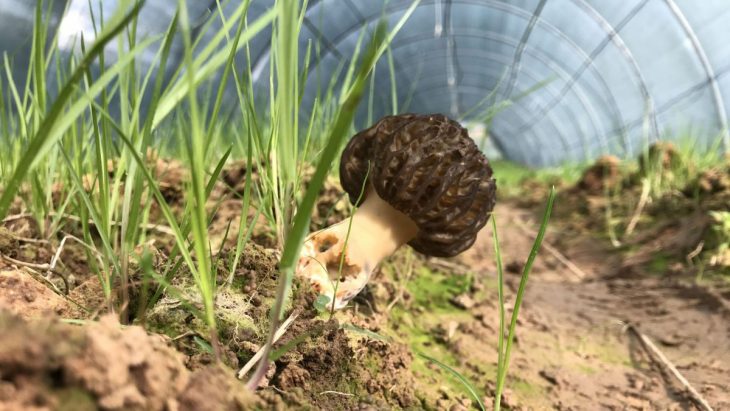
On December 14, 1980, Ower detected developing morel fruiting bodies in his continuing culture work. They matured and were harvested on January 11, 1981, then deposited in the San Francisco State University herbarium. After repeating the result, Ower published a brief scientific account in Mycologia in 1982.
That distinction matters. Ower did not simply report vigorous mycelium. He documented the development of mature morel ascocarps under controlled conditions—an achievement that gave later researchers a concrete biological pathway to investigate.
02
From university work to a U.S. patent
Ower’s work continued through a patent process with Gary L. Mills and James A. Malachowski. U.S. Patent 4,594,809, filed in 1985 and issued on June 17, 1986, described a method for cultivating Morchella, including the production and treatment of sclerotia and the environmental changes used to induce fruiting.
The patent made the California work legible to a wider cultivation industry. It helped establish the language of staged morel development, controlled inputs, and deliberate fruiting conditions that still appears across modern morel research.
It was a breakthrough, not the end of the problem. Later reviews describe early American commercial production as difficult to stabilize. That history is one reason serious morel farming cannot be reduced to a bag of spawn and a promise.
03
What happened after California
Morel cultivation continued to develop internationally. During the early twenty-first century, growers and researchers in China advanced field systems, including the use of external nutrition bags, and commercial cultivation expanded rapidly after 2012. Peer-reviewed reviews now describe thousands of hectares of field production alongside persistent challenges in strain quality, soil biology, disease control, weather, and yield stability.
Europe added another layer: controlled-environment practice, greenhouse discipline, substrate work, and commercial grower support. Those developments did not erase the California milestone. They extended a scientific conversation that began with one determined American researcher refusing to stop after an unsuccessful first phase.
04
Why the story matters to American growers now
The lesson is not that morels became easy. The lesson is that morels became cultivable when observation, biology, clean work, environmental control, and persistence were brought together as a system.
That is the standard Morels USA is bringing back to American land. A backyard bed and a commercial farm do not need the same infrastructure, but both need an honest seasonal plan, morel-focused inputs, records, and the discipline to learn from the site. No responsible grower can promise a harvest from biology alone. A serious system can make every decision more informed.
California gave modern morel cultivation one of its defining breakthroughs. The next American chapter will be written by growers who treat the crop with the same seriousness.
SOURCES
Read the record
Morel News separates documented history from promotional folklore. These are the principal records behind this edition.